What Foods Does Dr Pedre Say to Avoid?
If the "Health Liberty" motility has its way, everyone in the United States volition be able to practice medicine. It may be quack medicine but that doesn't seem to bother them. Short of that, chiropractors, naturopaths and acupuncturists are aiming to reinvent themselves principal care providers and even physicians. Equally David Gorski pointed out, this volition reduce medical doctors to merely some other iteration of physician, the "allopathic" type, equal in stature to the chiropractic, naturopathic and acupuncture types. These "physicians" already phone call themselves "medico" (east.g., "Dr. of Oriental Medicine") and claim to graduate from four-year "doctoral" programs. This despite the fact that their schools operate outside the mainstream American university system and avoid some of the basics of typical graduate programs, such as entrance exams, as well every bit the extensive clinical grooming required for medical doctors.
Consumers are confused by all of this, and who wouldn't be? In 2008 and 2010, surveys done for the American Medical Association by outside firms revealed that many patients did not know the qualifications of their healthcare provider. The comparisons were between centrolineal health professions (e.thou., audiologists and nurse practitioners) and medical doctors, but chiropractors were included. In 2008, 38 per cent of those surveyed (n=850) idea chiropractors were medical doctors, although that dropped to 31 per cent in 2010. All the same, we are talking about roughly one-3rd of the survey participants.
The surveys also asked about the use of the term "medico" and defoliation in advertising materials.
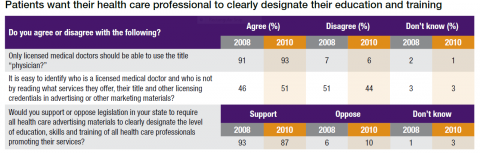
(Sorry, my visual aids are not as titillating as Dr. Gorski'due south, but I couldn't find any Penthouse covers relevant to this topic.)
Etiquette weighs in: a digression
Before nosotros go any further, let'due south digress into a topic raised in the comments of a previous postal service: who should use the title "Doctor," at least in what is referred to somewhat quaintly as "social settings." But first, a disclaimer: This advice only applies to the United States. Your state may have a totally different prepare of rules.
I consulted the experts on this, that is, the etiquette experts, people no one pays much attention to anymore. I found what is known in the legal field equally a "split of authorisation." Miss Manners (Judith Martin) says "Dr." should be reserved for those in the medical profession, although she also thinks people should be chosen what they want to exist called. So, if someone insists, then "Dr." it is. On the other hand, Letitia Baldridge, who served as social secretary to Jacqueline Kennedy Onassis when she was outset lady, is (or was, she passed away last year) of the opinion that your academic championship is also your social setting title. Emily Mail sides with Miss Manners. In social settings, she advises one showtime with past addressing both Ph.Ds and medical doctors as "Dr." and if the quondam prefer some other title, they will tell you.
So at present you know.
Truth in Healthcare Marketing
A bill introduced in the U.S. Business firm of Representatives, with bipartisan support, aims to clear things upwards in the professional person, if not social, setting. H.R. 1427, the "Truth in Healthcare Marketing Act," would prohibit whatever "deceptive or misleading" argument or act that "misrepresents" a person's "education, training, degree, license or clinical expertise." If H.R. 1427 becomes police, such misrepresentations would be a violation of the Federal Trade Commission Act, which prohibits, among other things, any unfair or deceptive ad or marketing practise.
Under the proposed Act, the information must exist deceptive or misleading, but the beak also specifies that it must "misrepresent" the education, grooming, degree, license or clinical expertise. But if information is deceptive or misleading, I would argue that it by definition it "misrepresents" so I am non articulate whether, equally a applied matter, that is an boosted requirement or not.
In any consequence, misrepresentation of a license or caste should be pretty clear cut, but I'm not sure where the boundaries might autumn around misrepresentation of one's education, training, or clinical expertise. Of course, there are ever the egregious cases, like the Colorado chiropractor challenge to exist an endocrinologist whose treatments could "reverse diabetes." Having a wimpy chiropractic board administer a frail wrist slap is ane thing; having the Feds after you lot is quite another.
Equally nosotros've noted on SBM, both naturopaths and chiropractors merits their instruction and training is sufficient to practice as a primary care physician. They promote the idea that their schools offer an education that is either the equivalent of, or shut to, that of a medical doc. A nautical chart handed out by naturopaths in back up of their Colorado licensing bill claims they have more than hours of instruction in pharmacology than medical doctors. And a chart published by the American Chiropractic Clan (ACA), posted below, purports to show that chiropractic students have more combined classroom and clinical hours than medical students. (The ACA fabricated like overblown statements in a cursory filed with a Colorado court.) Assuming these claims are made in a context otherwise covered by the Act (such as advertising by a chiropractor) would representations similar this pass muster under the proposed "Truth in Healthcare Marketing Act of 2013"?
Permit's wait at a description of chiropractic education from the American Chiropractic Clan'southward website. [Emphasis added.]
Chiropractic Education
Educational requirements for doctors of chiropractic are among the about stringent of any of the health care professions.
The typical bidder at a chiropractic higher has already acquired nearly four years of pre-medical undergraduate higher instruction, including courses in biology, inorganic and organic chemistry, physics, psychology and related lab work. In one case accepted into an accredited chiropractic college, the requirements become even more demanding — four to 5 academic years of professional report are the standard. Because of the hands-on nature of chiropractic, and the intricate adjusting techniques, a significant portion of time is spent in clinical training.
Doctors of chiropractic — who are licensed to do in all 50 states, the District of Columbia, and in many nations around the world — undergo a rigorous pedagogy in the healing sciences, similar to that of medical doctors. In some areas, such as anatomy, physiology, and rehabilitation, they receive more intensive education than most medical doctors or physical therapists.

Like other primary health care doctors, chiropractic students spend a significant portion of their curriculum studying clinical subjects related to evaluating and caring for patients. Typically, as function of their professional person grooming, they must complete a minimum of a one-yr clinical-based program dealing with actual patient intendance. In full, the curriculum includes a minimum of 4,200 hours of classroom, laboratory and clinical experience. [Then why does the chart say 4820?] The form of study is approved by an accrediting bureau which is fully recognized by the U.S. Section of Educational activity. This has been the case for more than 25 years.
Before they are allowed to practice, doctors of chiropractic must pass national lath examinations and get land-licensed. Chiropractic colleges as well offering mail-graduate continuing education programs in specialty fields ranging from sports injuries and occupational health to orthopedics and neurology. These programs let chiropractors to specialize in a healthcare discipline or meet land re-licensure requirements.
This extensive education prepares doctors of chiropractic to diagnose health care problems, treat the problems when they are within their scope of do and refer patients to other wellness care practitioners when advisable.
[Hmmm. The ACA says that "intricate adjusting techniques" are taught in chiropractic college every bit role of the "significant portion of time" spent in clinical training? And what do chiropractors "adjust"? Subluxations! And then much for the claims that detecting and correcting subluxations is not emphasized and is taught only as a historical concept in chiropractic schools.]
Misleading or deceptive?
Before we parse this description, note some of the relevant criteria past which the information is judged under the FTC Act.
- No intent to deceive must be present. Innocent misrepresentations are covered by the FTC Human activity.
- How an average or unsophisticated person, not the expert, would view the data is the standard. Would information technology mislead an average consumer?
- The data is looked at as a whole and tin be deemed deceptive fifty-fifty though the individual statements made are literally truthful.
- The claims made must be material to the consumer, that is, the data must be important to consumers and probable to affect their choice of, or conduct regarding, a product or service.
It is interesting to annotation that the ACA'due south discussion of chiropractic education may be, for the near part, literally true. (Although I seriously dubiety that the chiropractic student's pedagogy in anatomy or physiology is more "intensive" than that of a medical student, particularly considering their narrow focus on the musculoskeletal system.) But, as nosotros know, literal truth is not the standard. We have to await at the information taken as a whole.
Here is where I call back the information might be deceptive or misleading equally interpreted by the average consumer who would consider a health care provider's educational activity to exist important only who is not familiar with the wellness professional educational arrangement. Those more familiar with medical education tin probable add to my observations.
- Hours and agenda years are used to compare instruction, when in fact the number of hours or years is non an indication of quality or rigor. (By this standard, elementary school is more enervating than college.) Nor are classroom and clinical hours inclusive of all time spent in learning. What nearly time spent in independent inquiry?
- While the chart notes the years spent in residency are not included, failing to count those leaves out a substantial and important difference between chiropractic and medical teaching.
- At that place is no mention of the chiropractic pupil's focus on the musculoskeletal system or the fact that medical students take far more education in any number of subjects, such every bit pharmacology, primary intendance, and pediatrics as well as the body'southward other systems, such as cardiovascular and reproductive. Nor practice chiropractic students have clinical training in a multifariousness of specialties.
- There is no mention of the focus on the musculoskeletal arrangement in actual chiropractic practise. In fact, chiropractors are referred to equally main health care practitioners.
- The mention of "post-graduate" educational programs leading to "specialties," fails to note that these are generally express to courses taken over a number of weekends with little (perhaps no) actual clinical training.
My conclusion is that this description viewed equally a whole would get out the boilerplate consumer with the imitation impression that chiropractic education is equal in rigor and breadth to a medical education and qualifies graduates to practice as principal intendance physicians. Under federal police, this need not be the but interpretation possible to violate the FTC Act, but it is certainly one a reasonable consumer could attain. Again, nearly 1 third of survey participants actually thought chiropractors are medical doctors. To the extent that chiropractors apply similar data in their advertising and other communications with the public they would be vulnerable to suits challenge violation of the FTC Act.
Merely that'due south not all.
The bill also requires the FTC to undertake a study of healthcare professionals to:
- Identify acts and practices constituting a violation of the new police force, their frequency, and instances of harm or injury caused.
- Determine whether health care professionals are complying with state laws requiring disclosure of the type of license they agree.
- "Identify instances where whatever Land public policy has permitted acts and practices which violate section 3(a)," the department prohibiting deceptive or misleading statements, discussed above.
I, for one, will be more than happy to "identify . . . State policy" permitting these deceptive practices. For instance:
- Licensing chiropractors, naturopaths and acupuncturists every bit master intendance providers, either explicitly or de facto through wide scopes of exercise.
- Effectively giving out licenses to practice quackery by permitting such practices as the "detection" and "correction" of subluxations, prescribing homeopathic "remedies," iridology, cranial sacral therapy, free energy healing . . . well, I could go on and on. I will quote state laws and regulations, affiliate and poetry.
- Assuasive self-regulation (including the right to write their own regulations) through the creation of state board dominated past "CAM" practitioners. One time these practitioners are governed by their own boards, which have exclusive jurisdiction to discipline them, it is difficult to agree them accountable.
- Blindly accepting, lock, stock and barrel, whatsoever educational activity, testing, certification, training, continuing education, and the like these practitioners chose to create for themselves without whatever outside scrutiny (other than the Department of Teaching accrediting agency requirements, which reject scientific discipline as an appropriate standard for health care instruction).
If done properly, this report could exist at least a PR disaster for CAM providers. (Or not. Government reports about problems with dietary supplements do not seem to accept tempered the public's enthusiasm for supplements.) And it might fifty-fifty embarrass some states into actually instituting reforms, such as, say, a single, science-based standard for all health intendance practitioners.
If H.R. 1427 becomes police, I'll be sitting by the reckoner, Federal Merchandise Commission, waiting for your eastward-mail. You can achieve me through the SBM website.
Source: https://sciencebasedmedicine.org/dr-who/
0 Response to "What Foods Does Dr Pedre Say to Avoid?"
Post a Comment